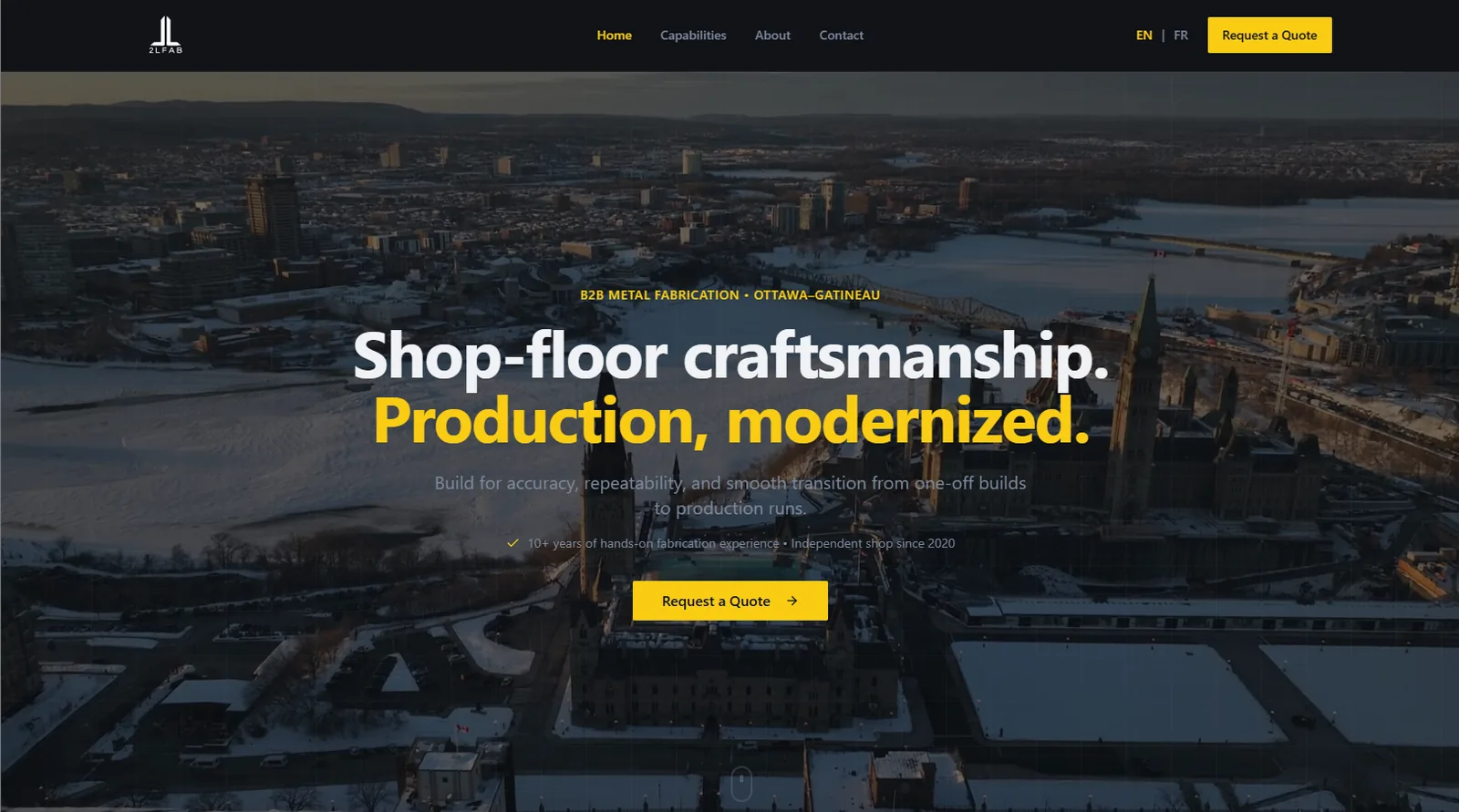
2LFAB Inc., Ottawa, ON
Past work and quote requests for a growing fabricator
A fabricator with real completed work and no good way to show it. Structuring the portfolio and the quote path mattered more than the visual refresh that came with it.
You already have a website. It was probably fine when it launched. Now traffic is flat or falling, the enquiries that do arrive are the wrong kind, and updating anything takes longer than it should. Somebody has said out loud that the site looks dated, and that is usually the point where a redesign gets budgeted.
The risk with redesigns is that looking dated is rarely the actual problem. Plenty of businesses spend well on a site that looks much better and converts exactly the same, because the thing holding it back was the offer, the structure, or the fact that nobody could find the page that answers the real question.
So we do not start by redesigning. We start by finding out what is wrong.
The first phase is a proper look at what you have. Which pages get traffic and from where, which ones people leave immediately, what people search for before they land, what happens between arriving and enquiring, and which pages already earn links or rankings you cannot afford to lose.
We also look at the parts analytics does not cover. What your sales team gets asked repeatedly. What competitors say on their equivalent pages. Whether the site loads acceptably on a phone. How long it takes an internal person to publish a change, and whether that friction is why nothing has been published in a year.
You get the findings whether or not you continue with us. Occasionally the honest answer is that you do not need a redesign, you need three new pages, a clearer offer and someone to fix your forms. We would rather tell you that than sell a rebuild.
A redesign that throws out everything is a redesign that throws out the parts that were working. Before anything is rebuilt we identify the pages that bring in qualified traffic, the copy that already explains the business well, the URLs with history behind them, and any integration that is quietly doing its job.
This is the difference between a redesign that grows and one that resets you to zero. Search engines have years of accumulated signal pointing at your current site. Discarding it by accident is expensive and slow to recover from.
In our experience the changes that make a measurable difference are unglamorous. Saying plainly what you do at the top of the page instead of three scrolls down. Giving each service its own page rather than one combined list. Showing real work. Reducing a nine field form to the four fields you actually act on. Making the phone number tappable. Answering price honestly, even if the honest answer is a range and an explanation.
Visual quality still matters, because a site that looks neglected suggests a business that might be. But it is the thing that gets you taken seriously, not the thing that gets you contacted. We treat it that way in the scope and in the budget.
Launch is the highest risk moment of a redesign and it is the part most likely to be rushed. Every existing URL gets mapped to its replacement, permanent redirects are in place before the switch rather than after, and anything with inbound links keeps working even if the page it points to has moved.
Alongside that: metadata carried over or improved deliberately rather than lost, structured data kept intact, the sitemap regenerated, analytics and conversion tracking verified against the new pages instead of assumed, and a check that the new site is actually indexable, because a staging setting left switched on is a genuinely common way to disappear from search for a month.
After launch we watch for a few weeks. Crawl errors, missing redirects, pages that lost traffic. Redesigns rarely go perfectly and the difference is whether anyone is looking.
Starting from nothing instead of from an existing site? Custom web design covers net new builds, where discovery replaces the diagnosis phase described above.
A redesign runs through the same five steps as a new build. The difference is that step one has evidence to work from, because the current site is already telling you where it fails.
01
We understand the real problem.
02
We identify what's possible and valuable.
03
We define the right solution and roadmap.
04
We design and build with purpose.
05
We measure what matters and keep improving.
A project where the existing material was the starting point.
2LFAB Inc., Ottawa, ON
A fabricator with real completed work and no good way to show it. Structuring the portfolio and the quote path mattered more than the visual refresh that came with it.
Send us the URL and what you expected it to deliver. We will look at it properly before recommending anything.